Personality Number: How the World Sees You in Numerology

Your personality number reveals the version of you that other people experience. Not who you are at your core — that is your soul urge. Not your talents or your life purpose — those belong to your expression number and life path. Your personality number is the outer layer: the first impression, the energy you project, and the mask you wear before anyone gets close enough to see what is underneath.
Derived from the consonants in your full birth name, the personality number describes how the world sees you — and how you unconsciously filter what you allow people to see. It is the front door to your inner world. Some people's front door matches the interior perfectly. Others project something entirely different from what they feel inside.
That gap — between who you appear to be and who you actually are — is one of the most revealing patterns in numerology. And it only becomes visible when you read the personality number alongside your other core numbers.
What Is a Personality Number?
A personality number is a core number in numerology calculated from the consonants in your full birth name. It represents the outward-facing aspects of your character — the traits others perceive when they first meet you, the energy you project in social and professional settings, and the qualities that shape how people describe you when you are not in the room.
If your soul urge number (from the vowels) represents your private inner self, your personality number (from the consonants) represents your public outer self. Together, they form the complete picture of your name's numerological identity — what you want on the inside and what you show on the outside.

How to Calculate Your Personality Number
Calculating your personality number requires your full birth name — first, middle, and last — exactly as it appears on your birth certificate. You will use only the consonants.
The consonants are every letter that is not a vowel. In Pythagorean numerology, the vowels are A, E, I, O, and U. Every other letter — including Y — is treated as a consonant.
Use the Pythagorean chart to convert each consonant to its number:
Step 1: Write out your full birth name.
Step 2: Identify every consonant in your name (remove the vowels A, E, I, O, U).
Step 3: Convert each consonant to its number and add them together for each name separately. Reduce each to a single digit or master number (11, 22, or 33).
Step 4: Add the reduced values together. Reduce the total to a single digit or master number.
Example: Maria Elena Torres
Maria: M(4) + R(9) = 13 → 1+3 = 4 Elena: L(3) + N(5) = 8 → 8 Torres: T(2) + R(9) + R(9) + S(1) = 21 → 2+1 = 3
Total: 4 + 8 + 3 = 15 → 1+5 = Personality Number 6
Maria Elena Torres has a Personality Number of 6 — she projects warmth, responsibility, and trustworthiness.
Want to skip the math? Calculate your personality number instantly → Our calculator determines all five core numbers and interprets how they work together — including the gap between your inner self and your outer projection.
Personality Number Meanings: 1 Through 9
Each personality number creates a different first impression — a different energy that people pick up before they know anything else about you. Your personality number does not describe who you are. It describes who you appear to be.
Your personality number is just one layer. See how it compares to your soul urge — what you show versus what you feel →
Personality Number 1
People see a leader. You project confidence, independence, and self-assurance — even when you do not feel it. Personality 1 walks into a room and people instinctively make space. Others perceive you as someone who has it figured out, who does not need help, who moves through the world on their own terms.
The gap: if your soul urge is a softer number like 2 or 6, people may never guess how much you crave connection behind that self-sufficient exterior.
Personality Number 2
People see a peacemaker. You project gentleness, approachability, and emotional intelligence. Personality 2 makes others feel comfortable — they open up to you quickly, sometimes more than they intended. You are the person others describe as "easy to talk to."
The gap: if your soul urge is a harder number like 1 or 8, your inner ambition and drive may surprise people who assumed you were content in a supporting role.
Personality Number 3
People see a communicator. You project charm, warmth, and creative energy. Personality 3 lights up social spaces — you are funny, expressive, and naturally magnetic. Others perceive you as someone who moves through life with ease and joy.
The gap: if your soul urge is a deeper number like 7 or 4, you may feel exhausted by the performance that comes so naturally. The person people see on stage is not always the person who goes home.
Personality Number 4
People see someone trustworthy. You project stability, reliability, and competence. Personality 4 is the person others turn to when something needs to actually get done — not because you are flashy, but because you are solid. People perceive you as grounded and dependable.
The gap: if your soul urge is 5 or 3, your inner restlessness and creative hunger may be entirely invisible to the people around you. They see the builder. They do not see the dreamer inside.
Personality Number 5
People see an adventurer. You project energy, charisma, and a magnetic openness to experience. Personality 5 draws attention without trying — there is something unpredictable and alive about the way you carry yourself. Others perceive you as exciting and slightly untameable.
The gap: if your soul urge is 4 or 6, you may crave far more stability and structure than anyone would ever guess from watching you in the world.
Personality Number 6
People see a nurturer. You project warmth, compassion, and a natural sense of responsibility. Personality 6 makes others feel cared for — people instinctively trust you with their problems, their children, their vulnerabilities. You are perceived as someone who holds things together.
The gap: if your soul urge is 1 or 5, your private desire for independence and freedom may conflict sharply with the caretaker role others expect from you.
Personality Number 7
People see a thinker. You project intelligence, depth, and a quiet intensity that others find either fascinating or intimidating. Personality 7 does not reveal much at first meeting — there is always a sense that more is happening behind the surface than you are willing to share.
The gap: if your soul urge is 3 or 2, you may desperately want the closeness and warmth that your exterior keeps at arm's length.
Personality Number 8
People see authority. You project power, competence, and material confidence. Personality 8 commands respect — not through volume, but through presence. Others perceive you as someone who operates at a level they aspire to reach. You project success whether you feel successful or not.
The gap: if your soul urge is 9 or 2, your private motivation may have nothing to do with power and everything to do with compassion or connection.
Personality Number 9
People see a humanitarian. You project warmth, idealism, and a certain graceful distance. Personality 9 is perceived as worldly, generous, and slightly beyond the concerns that occupy most people. Others see you as someone who cares about the bigger picture.
The gap: if your soul urge is 1 or 8, your inner drive for personal achievement may surprise those who assumed your motivations were entirely selfless.
Master Personality Numbers: 11, 22, and 33
When the consonants in your name reduce to a master number, your outer projection carries an amplified charge.
Personality Number 11
People perceive you as unusually perceptive — almost magnetic. You project a sensitivity and intuition that others find both compelling and slightly unsettling. Personality 11 gives the impression that you see things others miss. People are drawn to you without fully understanding why.
Personality Number 22
People perceive you as capable of something large. You project quiet authority combined with visionary energy — others sense that you are building toward something significant, even before you have told them what it is. Personality 22 commands trust at scale.
Personality Number 33
People perceive you as deeply compassionate — a natural teacher and healer. You project selflessness and spiritual warmth that draws others to you for guidance, comfort, and reassurance. Personality 33 is perceived as someone who makes others better simply by being present.
The Gap Between Your Personality Number and Your Soul Urge
This is where the personality number becomes genuinely useful — not as a standalone definition, but as one half of a comparison.
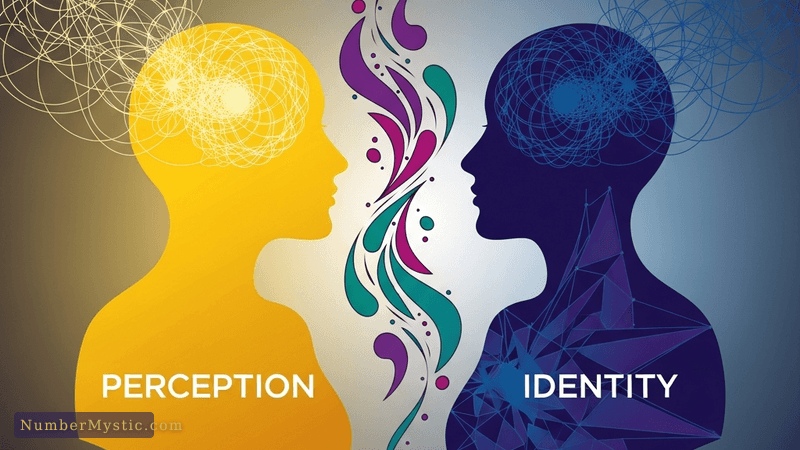
Your personality number (consonants) is what you show. Your soul urge number (vowels) is what you want. When these two numbers align, people experience you as authentic — what they see is what they get. When these numbers conflict, you carry a tension that can feel like living a double life.
Personality 7 + Soul Urge 3: You appear reserved and analytical, but inside you crave expression and connection. People see a thinker; you feel like a performer who never gets to take the stage.
Personality 1 + Soul Urge 2: You project independence and self-reliance, but privately you want partnership and closeness. The person who "needs no one" actually needs someone deeply.
Personality 6 + Soul Urge 5: You appear nurturing and responsible, but inside you crave adventure and change. Everyone depends on you, and part of you resents it — not because you do not care, but because you also need to be free.
Understanding this gap is not just self-knowledge — it is the key to understanding why certain relationships feel draining, why some roles fit like a second skin and others feel like a costume, and why people sometimes react to you in ways that feel disconnected from who you actually are.
Discover the gap in your own chart →Does Your Personality Number Change?
Your personality number is calculated from your birth certificate name, which does not change. Even if you adopt a new name — through marriage, legal change, or professional use — your core personality number remains tied to the consonants in the name you were given at birth.
That said, a name you use daily does carry its own vibration and may subtly shift the energy you project in that context. But the foundational personality number — the one calculated from your original name — stays with you for life.
Is Your Personality Number Who You Really Are?
No — and that is the point. Your personality number represents how others perceive you, not the full truth of who you are. It is one layer in a five-number system. Your true self emerges from the interaction between all five core numbers: life path (purpose), expression (talents), soul urge (desires), personality (perception), and birthday (secondary influence).
Knowing your personality number alone tells you something useful. Knowing how it fits with the rest of your chart tells you something true.
Calculate Your Full Numeric Blueprint →